
Travels in southwestern Africa
Made an expedition that he described in his subsequent travel writing.
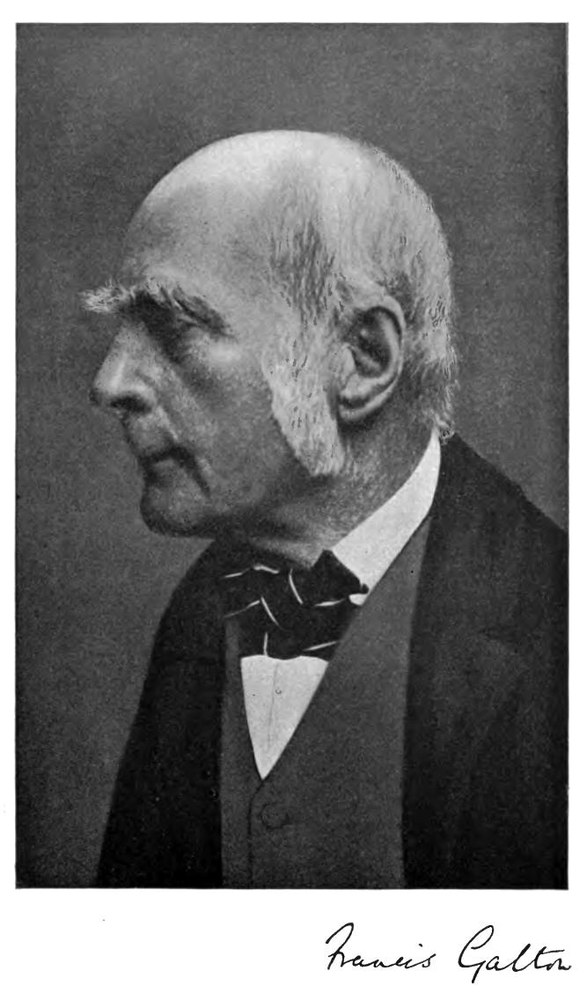
Statistician · Victorian Scientist
Francis Galton was a Victorian English statistician whose interests ranged from weather patterns to fingerprints. Born in Birmingham in 1822, he studied at Cambridge and traveled in southwestern Africa as a young man. He later collected observations from locations across Europe to make maps showing how weather conditions changed from day to day. The Royal Society’s archive holds papers from across his career, including his work on measuring how closely two sets of observations vary together.
Galton helped develop ideas that later became central to statistics, including correlation and regression toward the mean. The latter describes a simple pattern that can appear when measurements are repeated. An unusually high or low reading will often be followed by a less extreme one. Galton also investigated how fingerprints could be used to identify people and grouped their patterns into arches, loops and whorls. His work on fingerprints is described in the University of St Andrews biography.
Galton coined the word eugenics in 1883 and promoted the idea that society should encourage some people to have children while discouraging others. The movement rested on racist, classist and ableist claims about human worth. Eugenic ideas later helped justify coercive policies, including forced sterilization. University College London’s account of that legacy places Galton’s advocacy in the history of the institutions that supported it.
FAMILY, FRIENDS & COLLABORATIONS
Galton married Louisa Jane Butler in 1853.
Naturalist Charles Darwin was his half first cousin. They shared a grandfather, Erasmus Darwin. Statistician Karl Pearson later wrote a multi-volume biography of Galton and led the laboratory that bore his name.
EARLY CREATOR STORY
Made an expedition that he described in his subsequent travel writing.
Published Meteorographica, a collection of maps based on European weather observations.
Used the term in Inquiries into Human Faculty and Its Development.
Published Finger Prints, which set out methods for grouping fingerprint patterns.
EXPLORE THE DIRECTORY
BIRTHDAY TWIN FINDER
Find exact birthday matches among the people currently listed on TrendingBirthdays.
Only the month and day are compared in your browser. The date isn’t saved.
QUICK COMPARISON